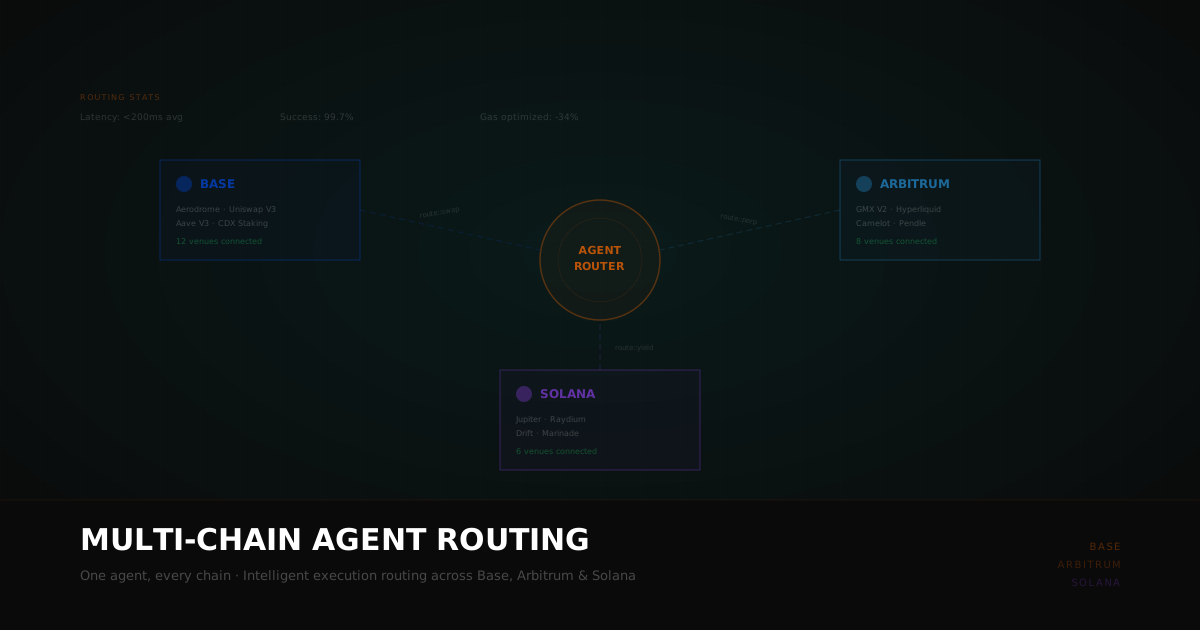
In March 2025, COD3X shipped its multi-chain agent routing layer — a unified execution system that lets autonomous agents operate across Base, Arbitrum, and Solana without protocol-specific logic. One intent, any chain, best execution.
The Problem: Chain Fragmentation#
DeFi liquidity is fragmented across chains. The best swap rate for ETH/USDC might be on Aerodrome (Base), while the best perpetual funding rate sits on Hyperliquid (Arbitrum L1), and the deepest SOL liquidity lives on Jupiter (Solana). Before multi-chain routing, agents were locked to a single chain — missing opportunities everywhere else.
Users had to manually decide which chain to use for each operation, bridge assets themselves, and configure separate agents per network. This defeated the purpose of autonomous execution.
How Multi-Chain Routing Works#
The routing layer sits between agent intent and on-chain execution. When an agent receives a high-level instruction like "maximize yield on idle USDC" or "open a 5x ETH long with the tightest spread," the router evaluates options across all connected chains simultaneously.
Route Resolution#
- Intent parsing — The agent's reasoning engine produces a structured action (swap, lend, open perp, provide liquidity)
- Venue discovery — The router queries available venues across all chains for that action type
- Cost modeling — Each candidate route is scored on execution cost (gas + slippage + bridge fees if cross-chain)
- Risk assessment — Routes are filtered by chain-level risk parameters (bridge security, liquidity depth, oracle reliability)
- Execution — The winning route is executed atomically where possible, or via a two-phase commit for cross-chain operations
Supported Action Types#
The router doesn't hardcode venue preferences. It queries live data — pool depth, funding rates, borrow APYs — and selects the best execution path for each operation at decision time.
Cross-Chain Bridging#
When the optimal route requires assets on a different chain, the router handles bridging automatically. The current implementation supports:
- Base ↔ Arbitrum — Native bridge for standard assets, fast bridge providers for time-sensitive operations
- EVM ↔ Solana — Wormhole for token transfers, with planned support for additional bridge protocols
Bridge operations are treated as a cost component in route scoring. If bridging adds 0.1% in fees but the destination venue saves 0.5% on execution, the router takes the cross-chain path. If not, it executes locally.
Bridge Safety#
All bridge operations include:
- Amount verification — Destination balance is confirmed before the agent proceeds
- Timeout handling — If a bridge takes longer than the configured threshold, the agent pauses and alerts
- Fallback routing — If a bridge is congested or down, the router re-evaluates with that bridge excluded
Gas Optimization#
Multi-chain routing also optimizes gas costs. Different chains have dramatically different fee structures:
- Base — Sub-cent L2 transactions, ideal for high-frequency small operations
- Arbitrum — Low fees with Nitro, good for medium-sized DeFi operations
- Solana — Fixed low fees, excellent for rapid-fire trading
The router factors gas into every decision. A lending position that earns 5% APY but costs $50 in gas to enter on Ethereum mainnet might earn 4.8% on Aave (Base) with $0.02 in gas. The router picks Base.
Agent-Level Configuration#
Users control routing behavior per agent:
Chain allowlist: [Base, Arbitrum, Solana]
Max bridge amount: $10,000
Bridge timeout: 15 minutes
Gas budget per operation: $2.00
Preferred chains: Base (for swaps), Arbitrum (for perps)
Agents respect these constraints absolutely. If a user restricts an agent to Base-only, the router never considers cross-chain routes — even if better rates exist elsewhere.
Performance#
After two months in production:
- Average route resolution: <200ms across all chains
- Execution success rate: 99.7% (failures are primarily gas estimation edge cases)
- Gas savings vs. single-chain: -34% average (by routing small operations to cheaper chains)
- Cross-chain operations: ~12% of all agent executions involve bridging
What's Next#
The routing layer is designed for horizontal scaling. Adding a new chain means implementing a chain adapter — a standardized interface for transaction submission, balance queries, and event monitoring. Current priorities:
- Additional EVM L2s — Optimism, zkSync, and Polygon are in the evaluation pipeline
- Intent-level batching — Grouping multiple agent intents into optimized multi-step routes
- MEV protection — Private transaction submission and flashbot integration for EVM chains
- Cross-chain position management — Unified portfolio view and rebalancing across all chains
Multi-chain routing removes the chain selection burden from both users and agents. One intent, best execution, any chain.