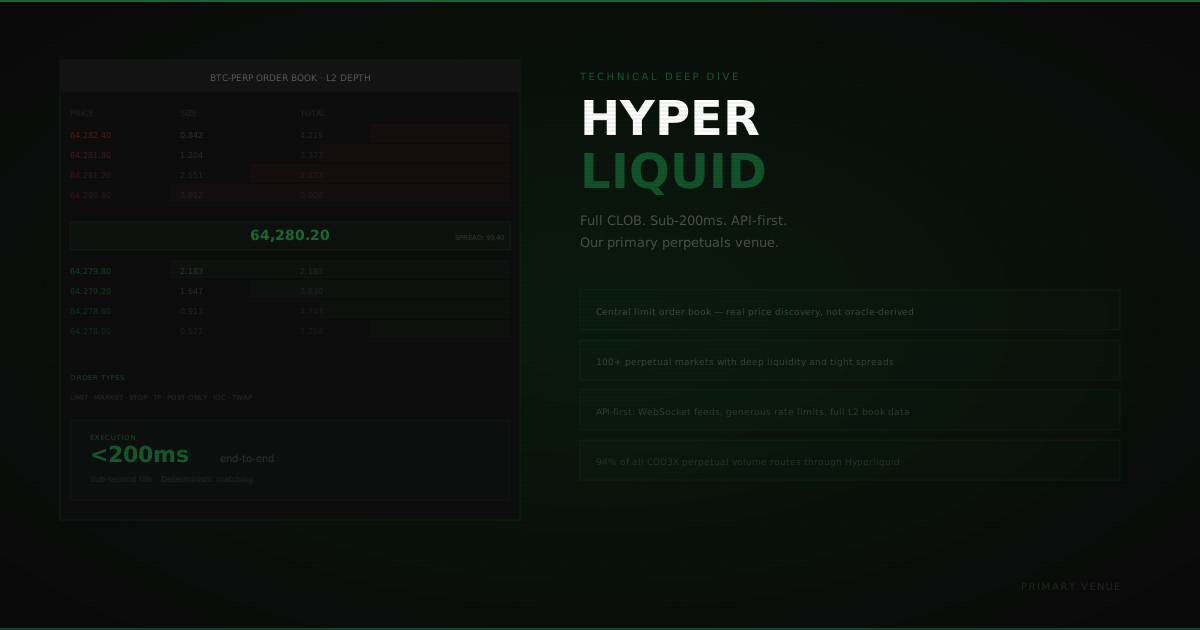
Hyperliquid is where COD3X agents trade perpetual futures. Not one of several options — the primary venue. 94% of all perpetual volume routed through COD3X already goes through Hyperliquid. Here's a technical evaluation of why.
Central Limit Order Book#
Hyperliquid runs a full CLOB — a central limit order book where every order sits at an explicit price level with explicit size. This matters for autonomous agents because:
- Price discovery is real — You see actual bids and asks from real participants, not oracle-derived prices
- Order types are rich — Limit, market, stop-loss, take-profit, post-only, IOC (immediate-or-cancel), reduce-only, TWAP
- Execution is deterministic — A limit order at a price fills when that price trades. No oracle lag, no execution uncertainty
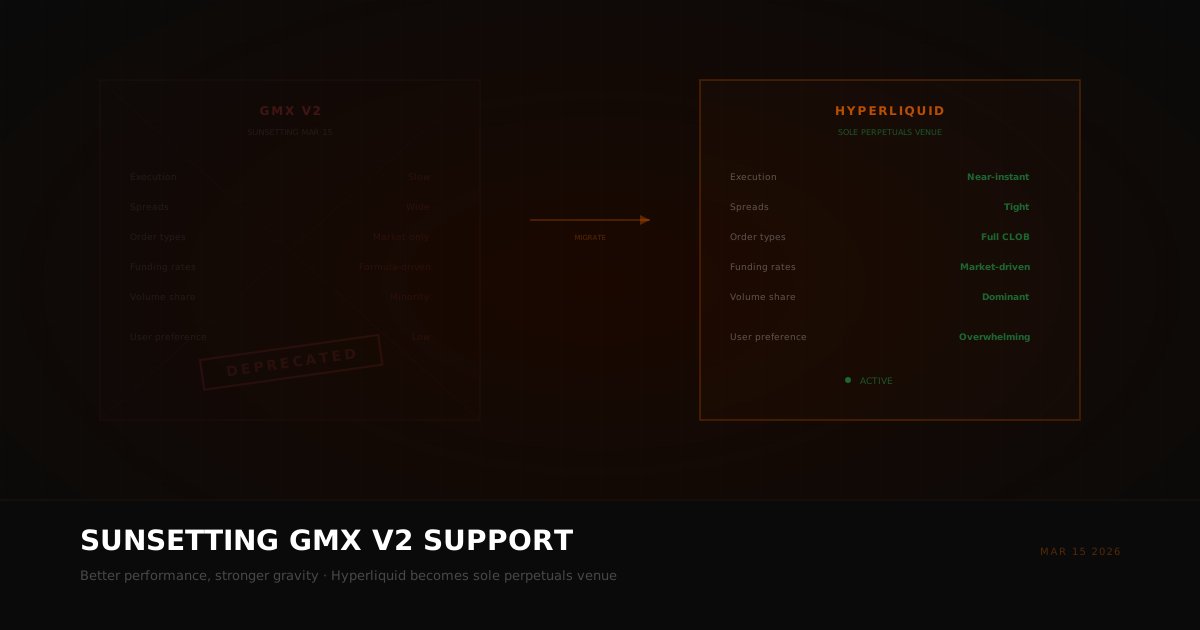
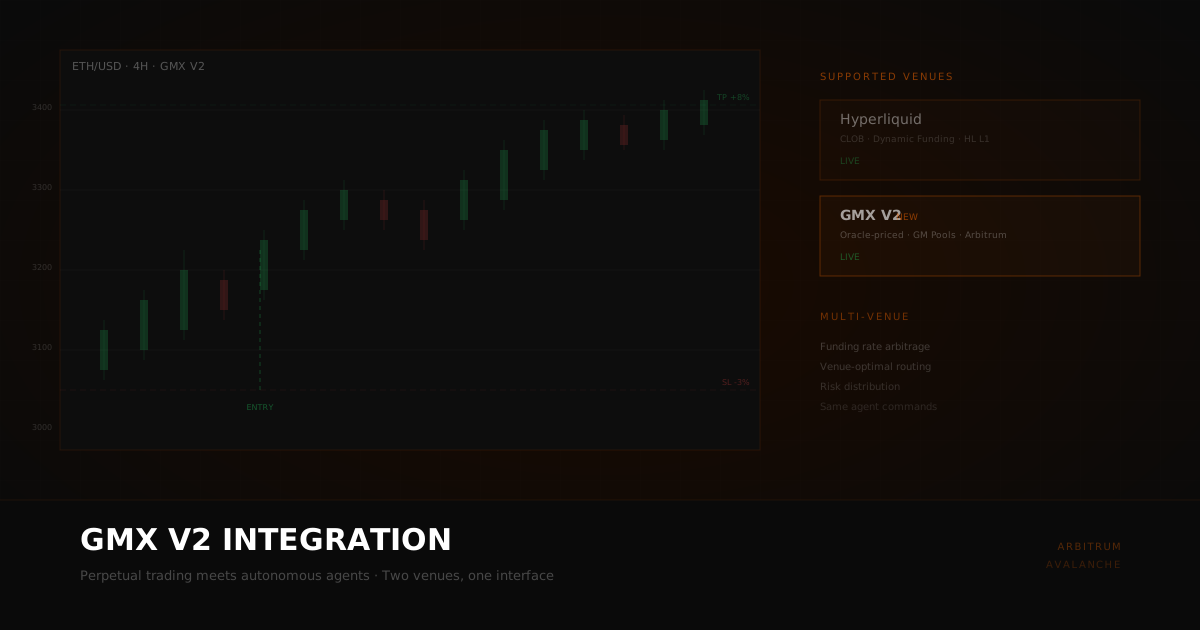
Compare this to oracle-priced models (like GMX V2) where prices are derived from external feeds with inherent latency. An agent placing a market order on an oracle-priced venue gets the oracle price, not the market price. That difference — even a few basis points — compounds across hundreds of trades.
Execution Speed#
Hyperliquid processes orders in under 200 milliseconds end-to-end. For an autonomous agent executing a momentum strategy on 15-minute candles, 200ms is negligible. But it matters for:
- Slippage reduction — Faster execution means less price movement between decision and fill
- Multi-leg strategies — Opening a hedge position immediately after an entry requires tight timing
- Goal chaining — When one goal triggers another on success, the second goal sees the current state, not a stale snapshot
Market Coverage#
100+ perpetual markets on Hyperliquid, including:
- Majors: BTC, ETH, SOL, AVAX, DOGE, LINK, ARB
- Mid-caps: PENDLE, JUP, WLD, TIA, SEI, SUI
- DeFi tokens: UNI, AAVE, MKR, CRV, SNX
- Memes: PEPE, BONK, WIF, FLOKI
Every market an agent can access is another strategy it can run. A momentum scanner checking ADX across 50 pairs needs broad market coverage — Hyperliquid delivers it.
What COD3X Agents Access#
The integration goes deeper than order submission. COD3X agents have programmatic access to:
L2 Order Book Depth#
Full level-2 order book data — every bid and ask at every price level. Agents use this to:
- Gauge real liquidity before sizing orders
- Detect large resting orders that might act as support/resistance
- Estimate slippage for large positions before executing
Real-Time Funding Rates#
Perpetual futures use funding rates to keep prices aligned with spot. COD3X agents access:
- Current funding rate per market (updated every 8 hours)
- Predicted next funding rate based on current premium/discount
- Historical funding rate data for carry strategy analysis
A funding rate harvester agent watches for extreme funding (>0.05% per 8h) and takes the opposite side, earning funding while hedging directional risk.
Historical Positions#
Access to historical position data from the Hyperliquid leaderboard. Agents can study:
- What top traders are holding
- Entry timing and position sizing patterns
- Sector rotation across top performers
Account State#
Real-time account data including:
- Open positions with unrealized PnL
- Pending orders with fill status
- Margin utilization and liquidation distances
- Historical trade log with fill prices
Order Types in Practice#
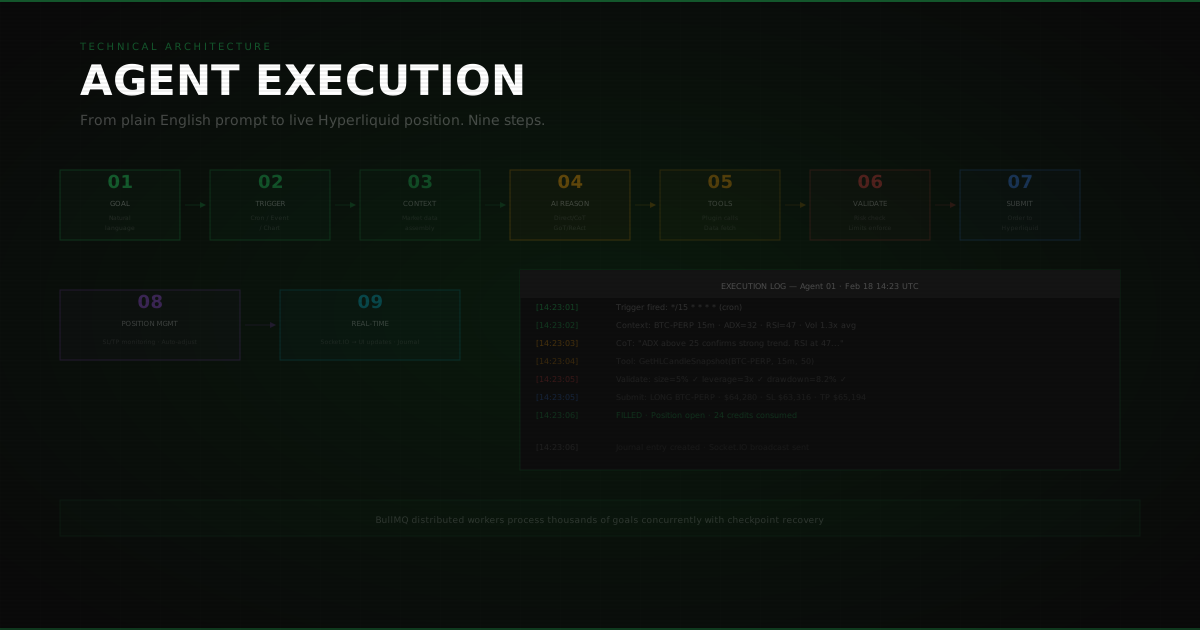
An agent running a trend-following strategy might use limit orders for entries (better price), stop-losses for risk management, and take-profits for exits — all submitted programmatically based on the goal's reasoning.
Funding Rate Mechanics#
Funding rates on Hyperliquid settle every 8 hours. When the perpetual trades above spot (positive funding), longs pay shorts. When below spot (negative funding), shorts pay longs.
COD3X agents use funding data in two ways:
- Carry strategies — Explicitly trading to capture funding payments. Enter the side that receives funding, hedge on spot, collect the rate.
- Entry filtering — Avoid entering long when funding is extremely positive (expensive to hold) or short when extremely negative. Funding conditions act as an additional signal layer.
API-First Design#
Hyperliquid was built API-first. The web interface is a client of the same API that COD3X agents use. This means:
- No feature gap between UI and API
- Rate limits are generous for programmatic access
- WebSocket feeds provide real-time updates without polling
- COD3X's proxy infrastructure handles rate limiting transparently during high-frequency operations
Why Not Multiple Venues#
The argument for a single primary venue is focus. Instead of maintaining integrations with five perpetual venues — each with different APIs, different order types, different settlement mechanics — COD3X goes deep on one.
Deep integration means:
- Full order book data, not just top-of-book
- Funding rate strategies, not just market orders
- Leaderboard analytics, not just price feeds
- Sub-account support (coming), not just single-account trading
Breadth across venues sounds good in theory. In practice, it means shallow integration everywhere and deep integration nowhere.
Hyperliquid gives COD3X agents a full order book, sub-200ms execution, 100+ markets, and the deepest perpetuals integration available. One venue, done right.