AI trading agents operate 24/7. They don't get tired, don't get emotional, and don't hesitate. That's their strength — and exactly why they need harder risk limits than human traders, not softer ones.
A human trader who's losing money eventually stops. They close the laptop, walk away, sleep on it. An agent with no guardrails will keep executing a failing strategy until the account is empty. Risk management isn't optional for autonomous trading. It's the foundation everything else is built on.
Configurable Risk Parameters#
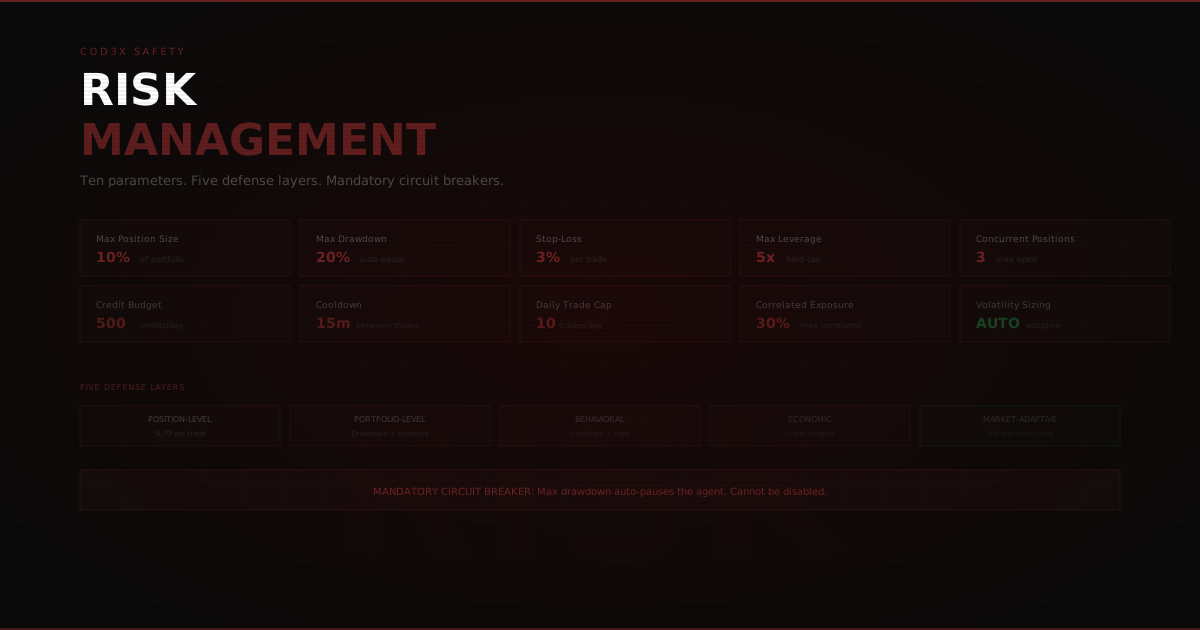
Every COD3X agent ships with configurable risk controls. These are enforced at the execution layer — the agent's AI can reason about any trade it wants, but the execution engine blocks anything that violates its constraints.
These parameters layer on top of each other. An agent has to pass through every check before a trade executes.
Defense in Depth#
No single parameter prevents all failure modes. Risk management works because the parameters layer:
Position Level#
Stop-loss and take-profit limit individual trade outcomes. A 3% stop-loss means no single trade can lose more than 3% of the allocated position — regardless of what the AI thinks the market will do.
Take-profit ensures winners are captured. Without it, an agent might hold a profitable position through a reversal, giving back all gains. The default 2:1 reward-to-risk ratio (6% TP vs 3% SL) means the agent only needs to win 34% of trades to break even.
Portfolio Level#
Max drawdown is the nuclear option. If the total portfolio drops 20% from its peak, the agent pauses completely. No new trades, no new goals. The operator must manually review and restart.
Max concurrent positions limits aggregate exposure. Three open positions at 10% each means 30% max deployment — 70% stays in cash. This prevents an agent from going all-in on correlated bets.
Behavioral Level#
Cooldown periods prevent overtrading. A 15-minute cooldown means the agent can't rapid-fire entries during volatile periods when the AI's confidence might be artificially inflated by noise.
Max daily trades is the hard cap. Even if every signal looks perfect, 10 trades per day is the limit. This forces the agent to be selective.
Economic Level#
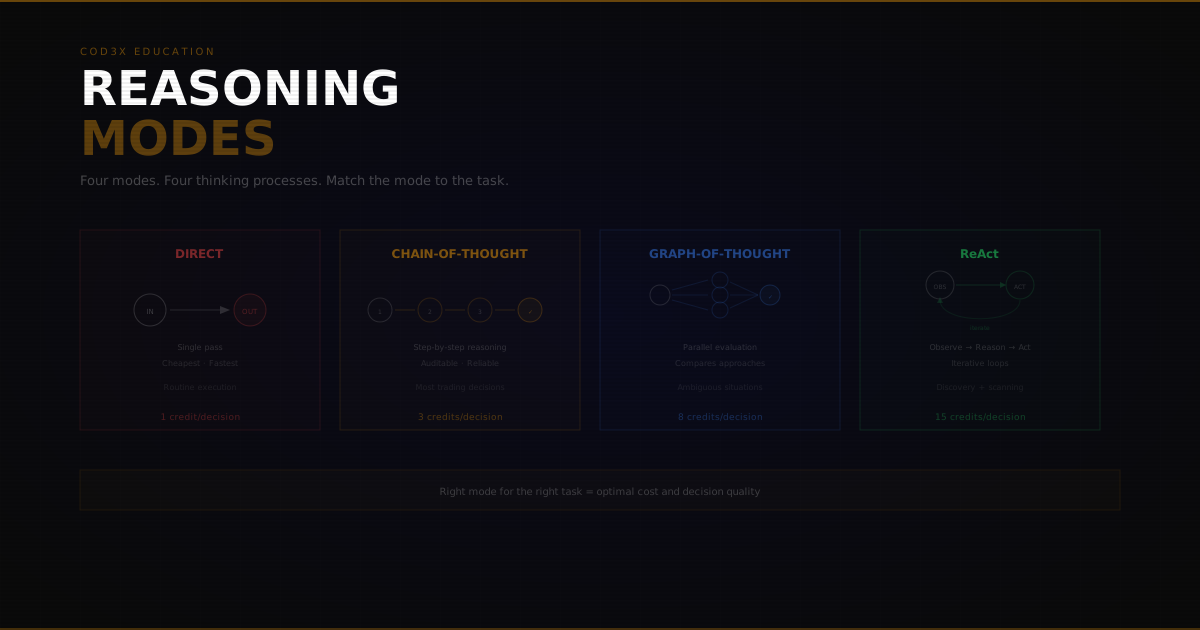
Credit budgets prevent runaway compute costs. An agent that enters an infinite ReAct loop — observe, reason, act, repeat — could burn through credits without ever producing a trade. The daily credit budget stops this.
When the budget depletes, the agent pauses until the next day. No silent credit drain.
Market-Adaptive Level#
Volatility-adjusted sizing is the most sophisticated layer. Instead of a fixed 10% position size, the agent scales position size inversely with current volatility:
- Low volatility (ATR < 1%): Full position size (10%)
- Normal volatility (ATR 1-3%): Standard size (7-8%)
- High volatility (ATR > 3%): Reduced size (4-5%)
- Extreme volatility (ATR > 5%): Minimum size (2%) or skip
This means the agent automatically reduces risk during volatile markets without needing a manual intervention. The AI doesn't need to "decide" to size down — the execution layer enforces it.
The Automation Paradox#
Here's the counterintuitive truth: the better an agent gets at execution, the more important risk management becomes.
A bad agent that loses money on every trade isn't dangerous — the operator shuts it down after a few losses. A good agent that's profitable 60% of the time but occasionally takes an outsized loss during a black swan — that's dangerous. Consistent profits build confidence. The operator loosens constraints. Then the tail event hits.
Risk management exists for the 1% of the time when conditions are nothing like what the agent was designed for. The stop-loss that seems too tight during a bull run is the parameter that saves the portfolio during a flash crash.
Goal-Level Risk#
Risk parameters aren't just set at the agent level. Each goal within an agent can have its own constraints:
- A momentum scalping goal might allow 5 concurrent positions with tight stops
- A swing trading goal on the same agent might allow only 2 positions with wider stops
- A funding rate harvester goal might have no position limit but a strict max leverage of 2x
This granularity means a single agent can run multiple strategies with appropriate risk parameters for each — without the conservative limits of one strategy constraining the others.
Defaults, Not Suggestions#
New agents on COD3X come with sensible default risk parameters. Operators can adjust them, but they can't remove them entirely. There is no "disable all risk management" toggle. The execution engine enforces minimum constraints even if the operator tries to set every limit to infinity.
This is a design philosophy, not a technical limitation. Autonomous agents managing real capital need mandatory guardrails. The operator chooses how tight the guardrails are. The platform ensures they exist.
AI agents trade faster, longer, and more consistently than humans. That's why they need harder limits — not softer ones. Configure your risk parameters before your first goal runs.