Every trading agent is an experiment. You tweak a parameter, swap a model, adjust a threshold — and sometimes the result is worse than what you had yesterday. Until now, there was no undo button.
This patch introduces agent version control — think of it as git for your trading agents. Every config change and goal modification is automatically versioned, browsable, and restorable. Alongside it: ICT market structure indicators hit the chart, a structured trading journal connects your reasoning to your positions, and goal chaining adds event-driven triggers between goals for emergency exits and failure recovery.

Agent Version Control#
The problem: You've been iterating on an agent's config for weeks. A late-night parameter tweak breaks something subtle — your agent starts entering positions too aggressively, or its stop-loss logic misfires. You can't remember exactly what changed or when.
The fix: Every modification to an agent's config and goals is now automatically snapshotted. You can browse the full history timeline, compare any two versions side-by-side, and restore selectively — rolling back just the config, just the goals, or both. It's non-destructive: restoring a previous version creates a new snapshot, so you never lose your current state either.
Your agent misread a CHoCH and went long into a reversal? Roll back two versions and redeploy in seconds — your pre-tweak config is right where you left it.
What else shipped for agents#
- Stale data warnings — Agents now surface a clear warning when they're operating on cached or outdated market data. No more silent decisions based on stale prices.
- Per-tool model selection — Assign different AI models to individual tools within a single agent. Use a fast model for data lookups and a reasoning-heavy model for trade decisions.
- Chat history management — Switch between past conversations, rename them for easy reference, and delete ones you no longer need.
- Cancel mid-execution — Stop an agent workflow mid-task without waiting for it to finish. Useful when you spot a mistake in real time.
- Inline tool calls — Every tool invocation now appears inline in the chat stream, so you can see exactly what data your agent pulled and what actions it took.
- New reasoning mode options — Additional reasoning configurations for fine-tuning how agents approach complex decisions.

ICT Market Structure on the Chart#
If you trade ICT concepts, you've probably been marking up Fair Value Gaps and Changes of Character by hand — or switching to a separate tool to spot them. That friction is gone.
Fair Value Gaps (FVG)#
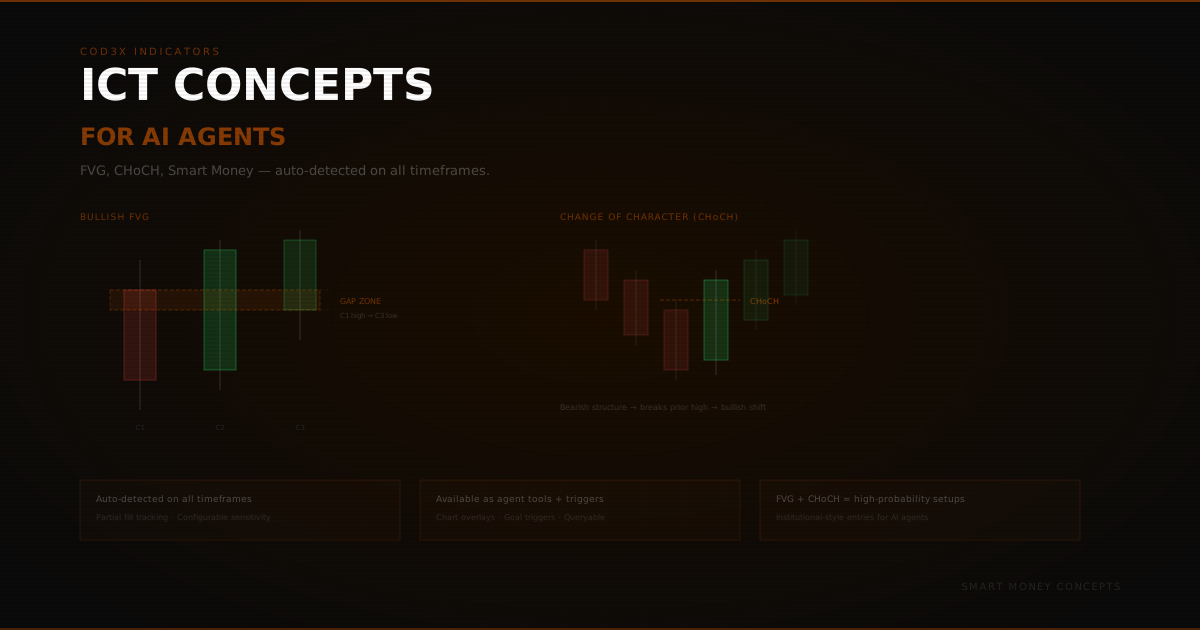
Fair Value Gaps are three-candle imbalances where price moves so aggressively that it leaves an unfilled zone on the chart. These gaps often act as magnets — price tends to return and fill them before continuing. COD3X now detects FVGs automatically, renders them directly on the chart, and lets you set alerts so you're notified the moment a gap forms or gets filled.
Change of Character (CHoCH)#
A Change of Character marks the moment market structure shifts — a bullish trend breaks a key low, or a bearish trend reclaims a key high. CHoCH detection is now built into the chart engine with full alert support. When structure breaks, you'll know immediately rather than catching it after the move.
Heikin Ashi Candles#
For smoother trend identification, Heikin Ashi candles are now available as a chart type with a persistent preference toggle. Switch once and it remembers your selection across sessions.
ADX Indicator#
The Average Directional Index (ADX) is now available on the frontend chart — a momentum-agnostic measure of trend strength that helps you distinguish trending markets from choppy ranges.
Goal Chaining: Event-Driven Automation#
Goal chaining lets you wire goals together: a goal can trigger other goals on start, on success, or on failure.
Update: With Sonnet 4.6 and Opus 4.6, a single goal can now handle full scan-analyze-execute workflows in one run. Most users run one goal per trigger or asset. Goal chaining is best suited for event-driven patterns that span multiple lifecycle stages:
- Emergency circuits — A risk-monitor goal triggers an emergency-exit goal on failure, then an alert goal on success
- Fallback logic — If a primary strategy goal fails, a conservative fallback goal activates with different parameters
- Cross-asset coordination — A macro-event scanner triggers per-asset analysis goals in parallel

Trading Journal#
Good traders keep journals. Now your agents can too.
The new trading journal provides structured entries with full market context — linked directly to positions and orders. Each entry captures the reasoning behind a trade, the market conditions at entry and exit, and the outcome. Over time, this becomes a searchable archive of every decision your agent (or you) made and why.
Journal entries auto-populate from open positions, so you spend less time on data entry and more time on analysis.
Agent Templates#
Building an agent from scratch every time is tedious. Agent templates let you save a proven configuration — tools, parameters, model assignments — and spin up copies in seconds. Create templates from any existing agent, edit them independently, and deploy when ready.
Bug Fixes & Polish#
- Fixed partial close sizing for short positions
- Fixed withdrawable amount calculation edge cases
- Cleaned up debug elements across the app
- Fixed chat input layout issues
- Fixed candle ordering and deduplication on chart load
Version control, market structure detection, multi-step automation — this patch is about giving you the tools to iterate faster and automate deeper. Next up: expanded ICT indicator suite, cross-agent communication, and the strategy marketplace.