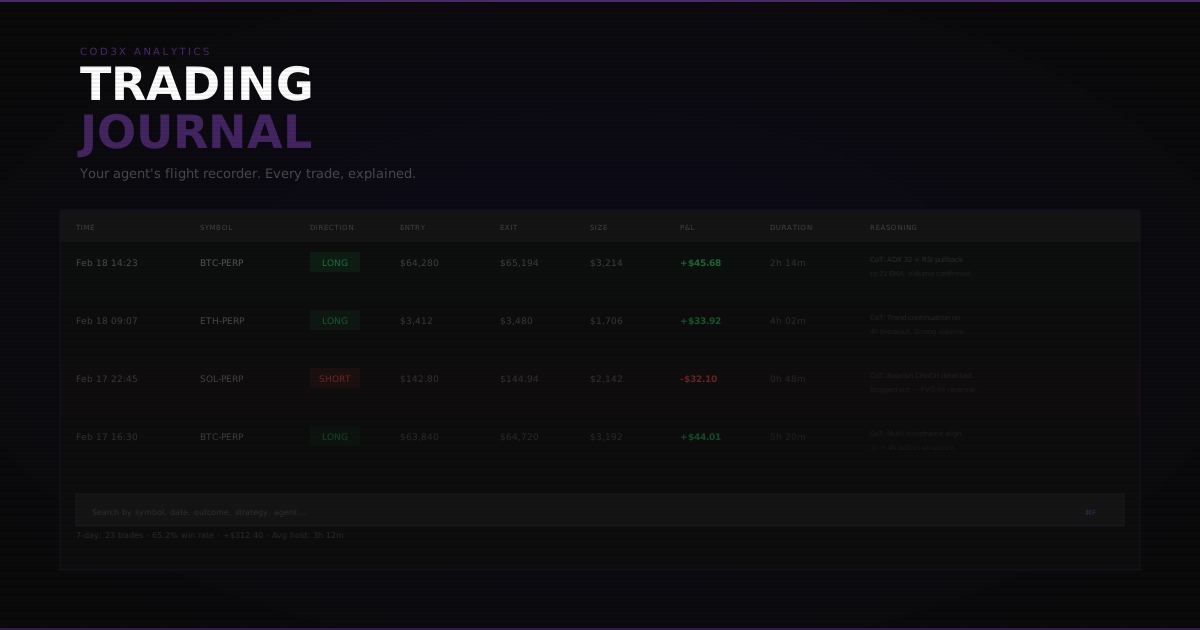
Every trade your agent makes is logged. The trading journal turns those logs into a structured, searchable archive of decisions and outcomes. Think of it as a flight recorder for your trading strategy.
What Gets Captured#
Every journal entry is linked to a position and includes:
Auto-Populated Fields#
These fill automatically when a position opens or closes:
AI-Generated Fields#
The agent's reasoning chain is preserved with each entry:
- Trade reasoning — The full analysis the AI produced before entering
- Market conditions at entry — Trend direction, volatility regime, key levels, indicator readings
- Market conditions at exit — What changed between entry and close
- Confidence score — How certain the AI was (0-100%) at time of entry
Manual Fields#
For human-initiated trades or additional context:
- Strategy tag — Label the strategy (momentum, mean-reversion, funding-harvest, etc.)
- Notes — Free-form text for personal observations
- Rating — Rate the trade quality (1-5 stars) separate from P&L outcome
Auto-Generation#
Journal entries create themselves. When you open a position through any COD3X agent, a draft entry is created with all auto-populated fields. When the position closes, the entry is finalized with exit data.
You don't need to remember to log trades. You don't need to fill in prices or calculate P&L. The system handles it. Your job is to add the context that only a human can provide — strategy tags, personal notes, quality ratings.
Search and Filter#
The journal is searchable across every field:
Combine filters: "Show all losing BTC short trades from the momentum strategy in January 2026." Instantly see what went wrong with a specific subset of trades.
Analytics#
The journal generates aggregate analytics from your entries:
Performance by Strategy#
See which strategies actually perform and which ones feel profitable but aren't when you look at the data.
Performance by Market#
How does your agent perform across different assets? Maybe it's excellent on BTC but mediocre on altcoins. The journal shows it.
Performance by Time#
Are your agent's trades better during certain hours? Certain days of the week? Certain market conditions (trending vs. ranging)? Time-based analytics reveal patterns invisible in real-time.
Hold Time Distribution#
How long are positions open? If your average winner is held for 2 hours and your average loser is held for 8 hours, that's a problem — losers are being held too long.
The Feedback Loop#
The journal isn't just a record. It's a refinement tool.
Pattern Recognition#
After 50+ journal entries, patterns emerge:
- "My agent performs best when ADX is above 30, not just above 25"
- "BTC shorts in the first hour after Asia open have a 70% loss rate"
- "Trades with AI confidence above 80% have a 65% win rate; below 60% have a 42% win rate"
These insights feed directly into goal refinement. Update the ADX threshold. Add a time filter. Set a minimum confidence threshold.
AI Review#
The journal data is accessible to the AI during reasoning. An agent can reference its own past trades:
"In the last 10 BTC long entries with similar conditions (ADX 26-28, RSI 48-52), the win rate was 40%. The current setup matches these conditions. Reducing position size from 5% to 3%."
The agent learns from its history — not through fine-tuning, but through context. The journal becomes part of the agent's decision-making input.
Export#
Full journal data is exportable to CSV for external analysis. Every field, every entry, every reasoning chain. Use it in spreadsheets, Python notebooks, or any analytics tool.
Every trade logged. Every decision recorded. Every pattern searchable. The trading journal turns raw trade history into actionable intelligence for both you and your agent.