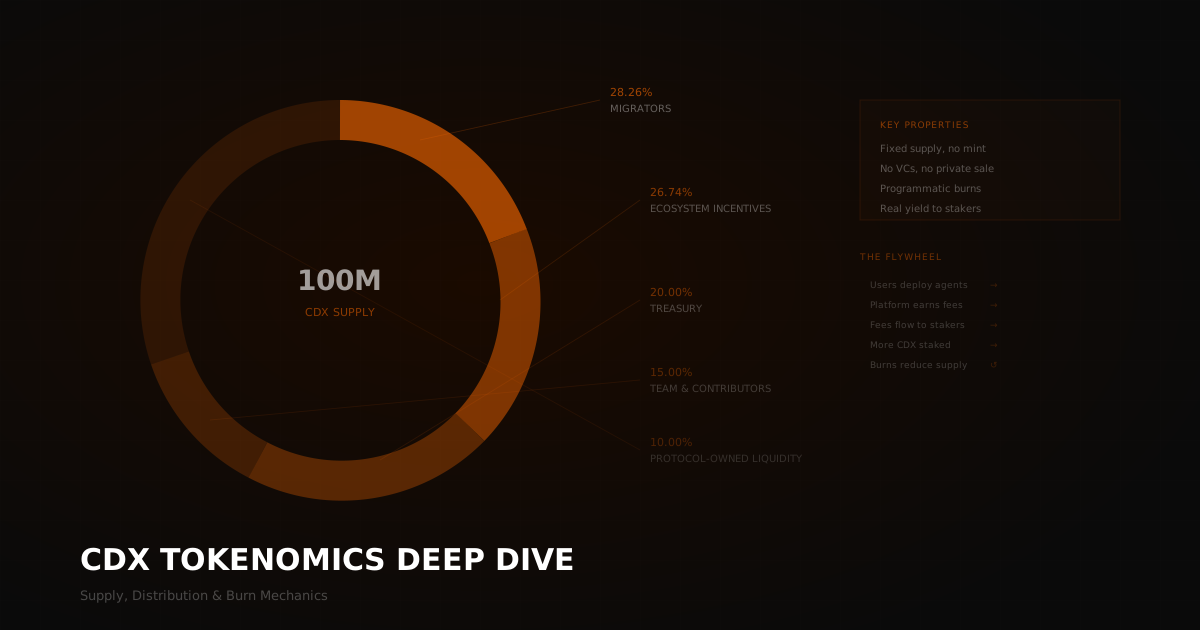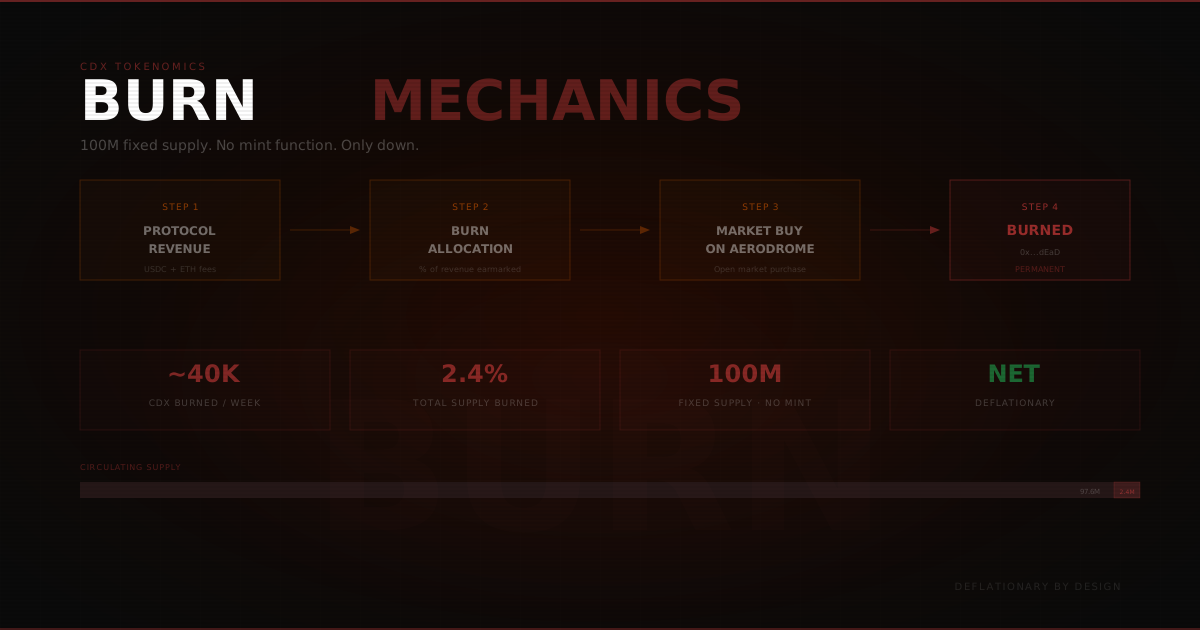
CDX has a fixed supply of 100,000,000 tokens. No mint function exists in the contract. That number only goes down.
Burns are the mechanism that makes it go down. Here's exactly how they work, what triggers them, and why they matter.
The Burn Pipeline#
Every burn follows the same four-step process:
- Protocol earns fees — Agent execution, trade fees, data access, credit purchases generate revenue in USDC and ETH
- A portion is allocated to burns — A fixed percentage of protocol revenue is earmarked for CDX buybacks
- Market buy on Aerodrome — The allocated USDC/ETH is used to purchase CDX from the open market via Aerodrome DEX on Base
- Send to dead address — Purchased CDX is sent to
0x000000000000000000000000000000000000dEaD— a provably unspendable address
Once CDX hits the dead address, it's gone. No governance vote can retrieve it. No admin key can recover it. The transaction is final and verifiable on-chain by anyone.
What Generates Burns#
Burns are downstream of protocol activity. Every revenue-generating action on COD3X contributes:
The key insight: burns aren't a fixed schedule. There's no "we burn X tokens on the first of every month." The burn rate scales directly with platform usage. More agents running, more trades executing, more credits consumed — more CDX burned.
The Math: A Worked Example#
Hypothetical monthly snapshot:
At that rate, 280,000 CDX per month is 3,360,000 CDX per year — 3.36% of total supply permanently removed. And this scales: double the platform activity, double the burn rate.
Programmatic, Not Discretionary#
Burns are programmatic. The allocation percentage is set at the protocol level and executes automatically. No team member decides "let's do a burn this week." No governance vote is needed to trigger a buyback. The system runs the same way whether the market is up 50% or down 50%.
This matters because discretionary burns create uncertainty. When a team announces a "burn event," the market prices it in ahead of time, the burn happens, and the effect dissipates. Programmatic burns create continuous, predictable buying pressure proportional to real economic activity.
Supply Squeeze Dynamics#
Burns alone create deflation. But burns combined with Reliquary staking create something more powerful: a supply squeeze.
Here's the math that matters:
- Total supply: 100,000,000 CDX (decreasing via burns)
- Staked CDX: Locked in Reliquary contracts, not circulating
- Protocol-owned liquidity: 10% of supply, permanently locked
- Treasury: Held for operations, not actively circulating
- Burned CDX: Permanently removed
The tradeable supply — what's actually available on the open market — is a fraction of the headline number. When a large percentage of supply is staked (and unstaking resets maturity, discouraging withdrawals), and another percentage is being steadily burned, the circulating float shrinks from both sides.
Compounding Deflation#
Each burn is permanent. Month one burns 280,000 CDX. Month two burns another 280,000 from a now-smaller total supply. The percentage deflation rate increases even if the absolute burn amount stays flat. And if platform activity grows — the entire point — the absolute amount grows too.
Year one: 3.36M CDX burned (3.36% of original supply) Year two (with 2x activity): 6.72M CDX burned (6.92% of remaining supply) Year three (with 3x activity): 10.08M CDX burned (11.16% of remaining supply)
These numbers are hypothetical, but the mechanic is real: burns accelerate as a percentage of remaining supply, especially when platform activity grows.
Transparency#
Every burn transaction is on-chain and verifiable:
- The dead address balance is publicly visible on BaseScan
- Aerodrome swap transactions show the exact USDC/ETH-to-CDX conversion
- The cumulative burn total is tracked on the COD3X operations dashboard
There's no trust required. The chain doesn't lie.
Every fee the protocol earns removes CDX from existence. No votes, no announcements, no discretion — just math.