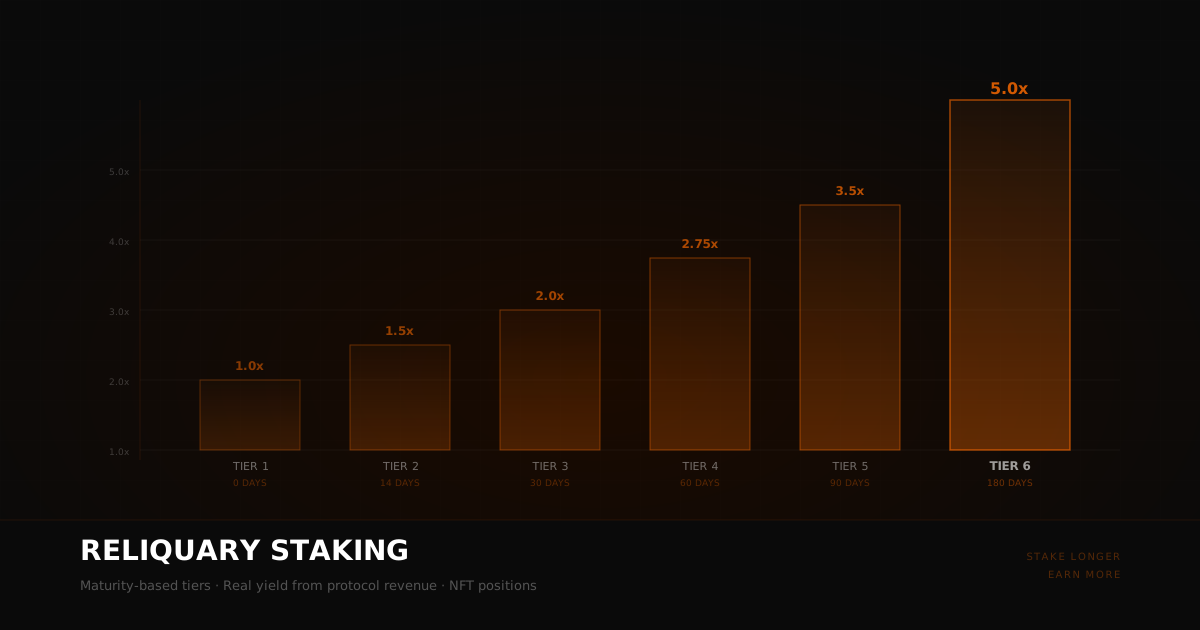
The original Reliquary staking launched with a simple premise: stake longer, earn more. Six maturity tiers, a linear multiplier up to 5x, and real yield from protocol revenue. It worked — but it was a starting point, not the final design.
CDX staking has been rebuilt from the ground up. The maturity system, reward formula, tier structure, and yield distribution have all been redesigned based on six months of production data and staker feedback.
What Changed and Why#
Original vs Upgraded: The Differences#
Every change has a reason. Here's the logic behind each.
The New Tier System#
The original tiers were numbered and based on how long you'd staked. The problem: a staker with 100 CDX at Tier 6 earned a 5x multiplier on a position that barely moved the needle for the protocol. Time commitment mattered, but economic commitment didn't.
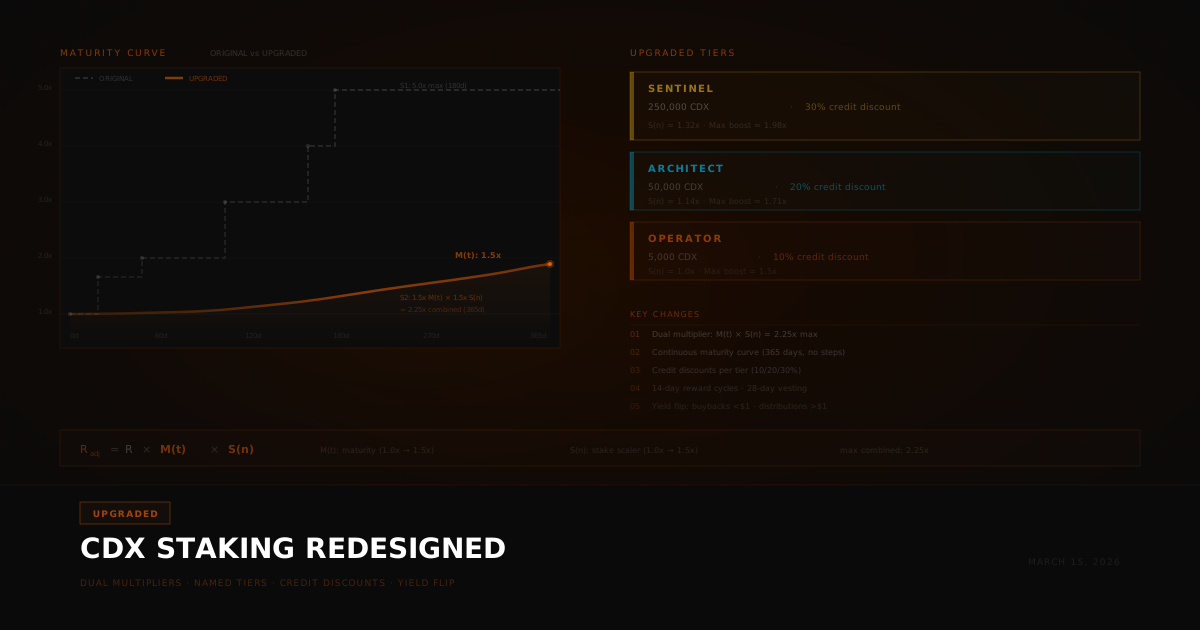
The upgraded system introduces three named tiers based on the amount of CDX staked:
The shift from time-only to amount-based tiers solves the free-rider problem that maturity tiers alone couldn't address. A SENTINEL with 250K CDX staked has real skin in the game — their staking position is directly tied to their economic interest in the protocol's success.
Credit Discounts: Staking as Platform Utility#
This is the biggest structural change. Originally, staking was pure yield farming — stake CDX, earn revenue share, collect yield. The staked CDX did nothing else.
Now, staking tiers unlock credit discounts for running agents on the platform:
- OPERATOR saves 10% on every agent inference, trade execution, and data query
- ARCHITECT saves 20%
- SENTINEL saves 30%
This creates a direct feedback loop between staking and platform usage. Heavy agent operators stake more CDX to reduce their operating costs. The staked CDX reduces circulating supply (complementing the protocol's burn mechanics). Reduced supply supports price. Higher price means the yield flip routes more revenue to stakers. Stakers reinvest.
The credit discount also means staking has utility independent of yield — even in periods of low protocol revenue, the discount is valuable to anyone running agents.
The Dual Multiplier System#
The original system had one multiplier: maturity. Stake for 180 days, earn 5x. Simple but one-dimensional.
The upgraded system introduces two independent multipliers that combine:
M(t) — Maturity Multiplier#
Your reward boost based on how long you've been staked. The curve is now continuous rather than stepped — no more discrete tier jumps.
Key milestones:
The maturity multiplier is deliberately flatter now. Why? Because it's no longer the only multiplier. The original system needed maturity to do all the work — rewarding commitment, filtering mercenary capital, creating yield differentiation. Now, the stake scaler carries the economic weight, and maturity provides a steady, compounding bonus on top.
The curve extends to 365 days (up from 180) and is polynomial rather than stepped. No more cliff edges where you jump from 2.75x to 3.5x at exactly day 90. Instead, your multiplier grows smoothly every day.
S(n) — Stake Scaler#
Your reward boost based on how much CDX you've staked. This is entirely new.
The formula is logarithmic: S(n) = clamp(1 + ln(n/α) / (2·ln(κ/α)), 0.9, 1.5)
Where α = 5,000 CDX (baseline) and κ = 1,000,000 CDX (cap).
In practice:
The logarithmic shape matters. It rewards increasing your stake at every level, but with diminishing returns. Going from 5K to 50K gives you +14%. Going from 500K to 1M only gives you another +10%. This prevents whale dominance while still rewarding larger commitments.
Combined Boost#
Your total boost is the product: Total Boost = M(t) × S(n)
Maximum: 1.5 × 1.5 = 2.25x
A SENTINEL (250K CDX) staked for a full year gets approximately 1.5 × 1.32 = 1.98x boost. That's their effective reward multiplier — every USDC of base yield is nearly doubled.
Compare this to the original system, where a small staker at Tier 6 earned a 5x multiplier on a trivial position. The new max boost is lower (2.25x vs 5.0x), but it's applied to economically significant positions, and combined with credit discounts that provide utility beyond raw yield.
Reward Cycle Redesign#
The original system distributed rewards continuously. The upgraded model introduces a structured cycle:
- Cycle length: 14 days
- Vesting period: 28 days per deposit
- New deposit per cycle: Fixed allocation from protocol revenue
- Carry-over: 50% of previous cycle's unvested rewards carry forward
This creates a geometric series that converges to a steady state:
Convergence formula: Total = Deposit / (1 − carry ratio) = 50 / (1 − 0.5) = 100M steady state
The benefit of this structure over continuous distribution is predictability. Stakers can model exactly how the reward pool behaves, when funds vest, and what the steady-state looks like. No surprises, no discretionary changes.
The Yield Flip#
The upgraded system introduces price-dependent revenue routing — a mechanism that didn't exist in the original:
- CDX below $1: 70% of protocol revenue → buybacks via Foundation LP. 30% → stakers.
- CDX above $1: 30% of protocol revenue → buybacks. 70% → stakers as USDC.
This creates a self-stabilizing loop:
- When CDX price is low, revenue concentrates on buying CDX from the market, supporting price recovery
- As price recovers past $1, revenue shifts to direct staker distributions, rewarding holders who stayed
- Higher distributions attract more stakers, which locks supply, which supports price
- Price stability keeps the flywheel in the distribution-heavy mode
The $1 threshold isn't arbitrary — it's the break-even point where the protocol determined buyback pressure provides less marginal utility than direct staker rewards.
Minimum Stake: 5,000 CDX#
The original system had no minimum. Anyone could stake any amount. This created noise — thousands of positions with 10 or 50 CDX that earned fractions of a cent in yield, congested the reward distribution, and provided no meaningful economic alignment.
The upgraded system requires a minimum of 5,000 CDX to stake. This is the OPERATOR threshold — the entry point to the tier system and the minimum position that earns credit discounts.
5,000 CDX signals genuine interest in the platform. It's accessible enough that active users can participate, but high enough to filter dust positions.
Unstaking Mechanics#
The core mechanic survives from the original: unstaking resets your maturity to zero. Your M(t) goes back to 1.0x regardless of how long you'd been staked.
The upgraded system adds a 7-day cooldown on unstake requests. When you request an unstake, the CDX remains locked for 7 days before it's released to your wallet. During cooldown:
- Your maturity continues accruing (it's not reset until the CDX actually leaves)
- You continue earning yield on the position
- You can cancel the unstake request to keep your position intact
The cooldown prevents reactive unstaking during short-term price volatility. It forces a deliberate decision with a one-week commitment — long enough to prevent panic exits, short enough to not feel like a hostage situation.
Migration: A New Reliquary#
The upgrade isn't a patch on the original contract — it's a new Reliquary. Existing stakers will migrate their CDX into the upgraded Reliquary to access the new mechanics.
What this means in practice:
- Maturity resets to zero. The new Reliquary starts a fresh M(t) curve for every position. Your accumulated maturity from the original system does not carry over.
- Your staked amount now earns an S(n) multiplier that didn't exist before — immediate benefit from day one, independent of maturity.
- You gain credit discounts based on your tier (OPERATOR / ARCHITECT / SENTINEL) the moment you stake into the new Reliquary.
- The yield flip mechanism adds a price-stabilization layer that protects your position value.
- Structured reward cycles give you visibility into when and how much you'll earn.
The maturity reset is intentional. The new continuous curve is designed around a 365-day horizon with a deliberately flatter shape — it's no longer the primary driver of your boost. The S(n) stake scaler and credit discounts provide immediate value that the original system never offered. Early migration means earlier maturity accrual on the new curve.
CDX staking, upgraded: new Reliquary, dual multipliers, named tiers with credit discounts, structured reward cycles, and the yield flip. Redesigned mechanics for the next era of CDX. For the full token economics, see the CDX tokenomics deep dive.