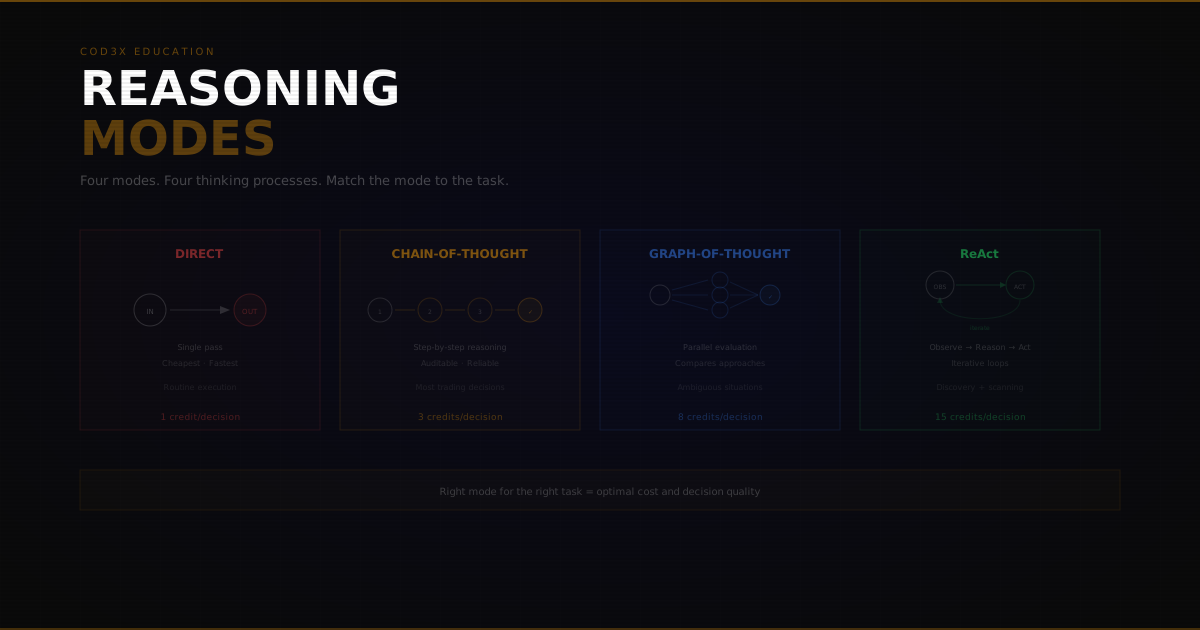
COD3X agents have four reasoning modes. Each one changes how the AI thinks — not what it thinks about, but the process it uses to arrive at a decision. Choosing the right mode for the right task is the difference between an efficient agent and one that burns credits for no reason.
The Four Modes#
Direct#
Single-pass execution. No reasoning chain. The AI reads the goal and context, makes a decision, and acts.
How it works: One inference call. Goal + context in, decision out. No intermediate steps.
Credit cost: Lowest. One API call per decision.
Speed: Fastest. Sub-second decisions.
When to use:
- Routine order placement ("place a limit buy at $60,000")
- Simple data lookups ("what's the current funding rate?")
- Pre-defined actions with no ambiguity
- High-frequency triggers where speed matters more than analysis
When not to use:
- Complex multi-factor trade analysis
- Situations where you want to review the AI's logic
- Anything where the wrong decision is costly
Direct mode is a hammer. Fast, cheap, no nuance. Perfect for nails, terrible for everything else.
Chain-of-Thought (CoT)#
Step-by-step reasoning. The AI walks through its analysis sequentially before making a decision.
How it works: The AI writes out its reasoning: "Step 1: Check trend direction. BTC is in an uptrend on 4h based on higher highs and higher lows. Step 2: Evaluate entry timing. RSI is at 52, pulling back from 68 — momentum is cooling but not bearish. Step 3: Check volume. Above 20-period average, confirming interest. Step 4: Decision — enter long with 3x leverage."
Credit cost: Moderate. One extended inference call with a longer output.
Speed: A few seconds. The reasoning chain takes time to generate.
When to use:
- Complex trade analysis with multiple factors
- When you want to review why the agent made a decision
- Multi-indicator evaluation (ADX + RSI + EMA + volume)
- Any situation where the reasoning matters as much as the outcome
When not to use:
- Simple, unambiguous tasks (use Direct)
- When you need to compare multiple strategies (use GoT)
- Open-ended discovery tasks (use ReAct)
CoT is the workhorse. Most trading decisions benefit from step-by-step analysis.
Graph-of-Thought (GoT)#
Parallel strategy evaluation. The AI explores multiple approaches simultaneously and picks the strongest branch.
How it works: The AI spawns multiple reasoning paths:
- Path A: "Momentum entry — ADX is strong, enter on pullback"
- Path B: "Mean reversion — price is extended, fade the move"
- Path C: "No trade — conflicting signals, sit this one out"
Each path is evaluated independently. The AI then compares them and selects the highest-conviction option.
Credit cost: High. Multiple parallel inference paths, each generating a full analysis.
Speed: Slower. Multiple paths must complete before comparison.
When to use:
- When the optimal approach isn't obvious
- Comparing strategies (momentum vs. mean reversion vs. hold)
- Multi-timeframe analysis (15m says buy, 4h says sell — which wins?)
- High-value decisions where credit cost is justified by decision quality
When not to use:
- When the strategy is well-defined (use CoT)
- Simple tasks (use Direct)
- When credit budget is tight
GoT is the strategist. Use it when you genuinely don't know which approach is best and want the AI to evaluate alternatives.
ReAct (Reason + Act)#
Iterative observe-reason-act loops. The AI gathers information, reasons about it, takes an action, observes the result, and repeats.
How it works:
- Observe: Check BTC funding rate → 0.04%
- Reason: Elevated funding suggests longs are crowded. Check if there's a trade.
- Act: Pull order book depth for BTC-PERP
- Observe: Large ask wall at $63,000, thin bids below $62,500
- Reason: Order book confirms potential for a flush. Short setup forming.
- Act: Check correlated assets (ETH, SOL funding and positioning)
- Observe: ETH funding also elevated, SOL neutral
- Reason: BTC/ETH correlation high, both showing crowded longs. SOL uncorrelated — skip.
- Act: Enter short BTC-PERP and ETH-PERP, skip SOL
Credit cost: Highest. Multiple inference calls per decision, each with tool invocations.
Speed: Slowest. Multiple round-trips between reasoning and action.
When to use:
- Open-ended market scanning ("find the best setup across 50 pairs")
- Complex research tasks ("analyze what top traders are doing and find patterns")
- Adaptive strategies that need to gather information before deciding
- Situations where the agent needs to explore before committing
When not to use:
- Well-defined strategies with clear rules (use CoT)
- Simple execution tasks (use Direct)
- When credit budget is limited
ReAct is the researcher. It's expensive but thorough. Use it for discovery and exploration, not routine execution.
Comparison Table#
One Goal, One Mode#
With Sonnet 4.6 and Opus 4.6, a single goal can handle an entire scan-analyze-execute workflow in one run. The model holds the full context — scanning markets, analyzing setups, evaluating risk, and executing trades — without losing coherence. Most users now run one goal per trigger or asset.
Pick the reasoning mode that fits the job:
- CoT for most single-asset strategies — scan, analyze, and execute in one pass
- ReAct when the agent needs to explore unfamiliar territory or scan many markets
- GoT when comparing fundamentally different approaches to the same opportunity
- Direct for pure execution where the decision is already made externally
Goal chaining — wiring multiple goals together — is still available for emergency exits, cross-asset coordination, and failure recovery, but is no longer needed for typical trading workflows.
The Cost-Quality Tradeoff#
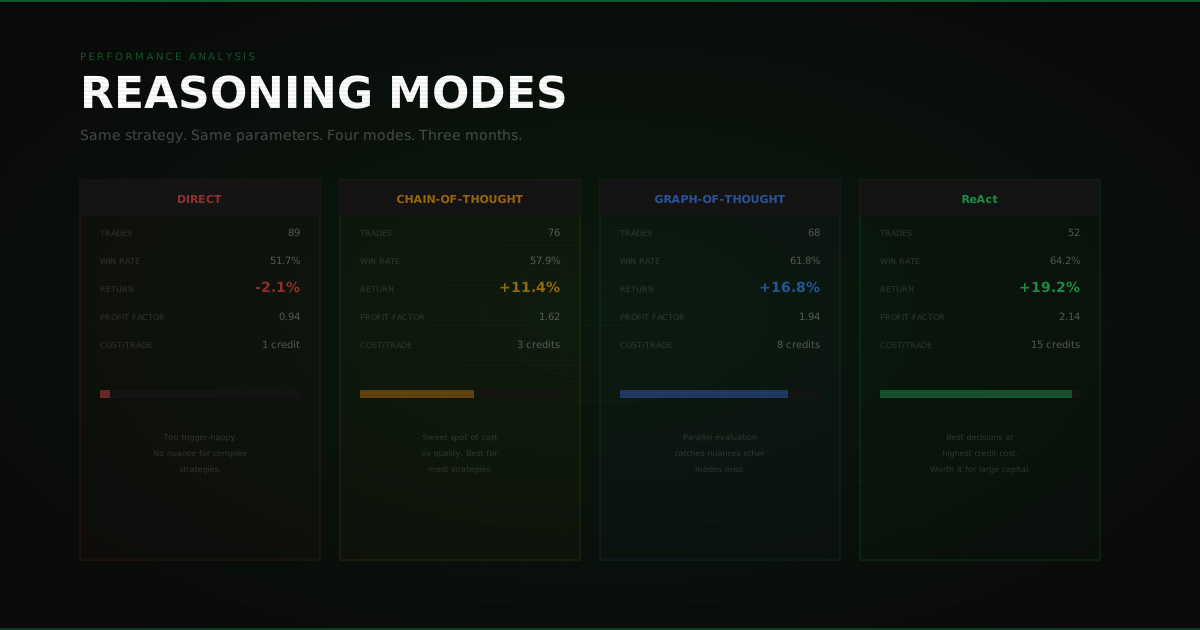
More expensive modes produce better decisions — but with diminishing returns. The jump from Direct to CoT is dramatic: the agent goes from blind execution to reasoned analysis. The jump from CoT to GoT is meaningful but smaller: the agent considers alternatives instead of committing to the first approach. The jump from GoT to ReAct is situational: valuable for discovery, marginal for well-defined strategies.
For most users, CoT is the default. It's the best ratio of decision quality to credit cost. Use GoT when the stakes are high or the approach is unclear. Use ReAct for scanning and discovery. Use Direct for execution-only tasks. For a data-driven comparison of all four modes on the same strategy, see our reasoning modes benchmark.
Four reasoning modes: Direct for speed, Chain-of-Thought for analysis, Graph-of-Thought for comparison, ReAct for discovery. Match the mode to the task.